Sake haiku (7th of December 2012)

Let me just enjoy myself,
And in lives to come
I'll be perfectly content
To be a bug, a bird.
(Otomo Tabito, translated by Edwin Cranston)
Drunkenness and drinking are common themes of Japanese and Chinese poetry, and although they are not directly mentioned in the
tanka (above) of Otomo Tabito (665-731), when Tabito says "enjoy" he in fact means "drink". This can be directly inferred from
his 13 chained tankas devoted to sake, one of which was used as the text for the PovRay illustration shown above. Here is another
Otomo's tanka, from which one can obviously see that he is indeed glorifying sake and drinking:
People seeking wisdom and
Not drinking;
Look on them well
Don't they seem like monkeys?
(Otomo Tabito, translated by Thomas McAuley)
Tabito was a governor of Daizafu, the administrative center of Kyushu island, thus I made a ceramic sake set
(with his name) so to look elegant and expensive, perhaps appropriate for someone of his rank. It is more
probable, though, that in late 7th century Tabito drank cloudy sake, and not the one highly refined and
transparent I "poured" in the cups.
From Tabito's poetry we might conclude that getting drunk is a glamorous activity. Everyone who did it knows
that there is nothing glamorous about it. Tabito hides the most important parts of the truth regarding
drunkenness.
But, in this post, I am more interested in another drunkard and poet -
Taneda Santoka (1882 - 1940). Santoka wasn't
a governor of anything and he spent seemingly unhappy life which was, since his eleventh year, marked by
the suicide of his mother, which she apparently committed because of her cheating husband. Santoka was
raised by his grandmother, and whole of his life was marked by constant drinking which left him outside
of community, irrespectively of his great poetic talent. He couldn't keep a job and all he was able
to do was wandering and writing sad haiku poetry marked by his addiction to sake. The addiction probably
killed him in the end. One can learn more about it all from
the >> article in Wikipedia.
Santoka's haiku has a free form and it doesn't follow 5-7-5 syllable rule. Santoka thus departs from the
traditional haiku, but his poetry can be still classified as haiku, although it does not fit there with
regards to form. It does fit in there, however, with regards to the spirit, because it remains faithful
to revealing the whole world in a moment, in a single experience - in this, Santoka was a sad master.
The image below shows a wooden measure boxes for sake (masu) which were used as cups also. Masu
that I coded in Povray has the name of Taneda Santoka engraved in it.
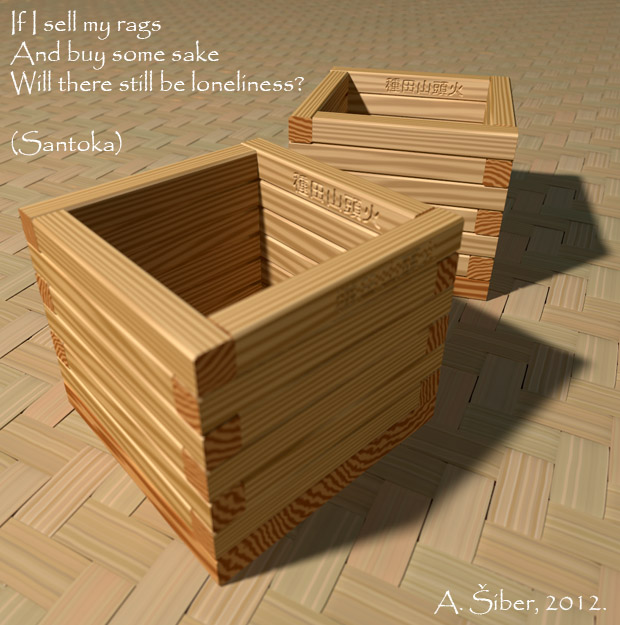
And buy some sake
Will there still be loneliness?
(Santoka, translated by Burton Watson)
And below, I bring some more examples of Santoka's poetry, which, I think rightfully, can be called haiku, although
they do not follow the traditional 5-7-5 form.
I slept
with the crickets!
(Santoka, translated by Burton Watson)
The drunkard dances all night.
(Santoka, translated by Burton Watson)
far off close by
how much longer to live
(Santoka, translated by Burton Watson)
In the end, I remembered the book I recently read, about Jack Kerouac's drunken wandering in Paris
where he attempts to research his French i.e. Breton ancestry. While doing his feat, Kerouac is
always on the edge, on the outside of the society he came to see, mostly because he is constantly
drunk, so they ignore him in the library, and even his French publisher who made some decent money
on Kerouac, does not want to meet him. Kerouac accepts all of this seemingly carelessly, with the
attitude of a merry drunkard who, in the end, does not care about it all, as long as he has
something to drink.
I read the book with a constant sour-sweet feeling because I knew that Kerouac died from the bleeding
in the esophagus which was almost certainly caused by his excessive drinking. That is why I could not
laugh at his sillinesses from the bottom of my heart.
The book is called "Satori in Paris" which also links Kerouac to Santoka - satori is the term which is
in Zen used for enlightenment, for the recognition of the true nature of reality. Santoka spent a part of
his gloomy and drunk life as a Zen disciple.
| << Drawing with postscript I | Marko Marelja's anamorphosis >> |
Last updated on 7th of December 2012.