Akahito's waka (24th of November 2010)
Waka is a form of Japanese poetry made of two strophes, the first of them having three verses with typically 5-7-5 syllables
(kami-no-ku) and the second one two verses, typically with 7-7 syllables (shimo-no-ku).
>> Waka
is a precursor of >> haiku form that was created by dropping out the
second strophe of waka.
Waka is kitsch. Haiku is kitsch. Waka and haiku are greatest art. All the statements are corrects although they are contradictory.
This is also in the spirit of Buddhist philosophy that importantly influenced development of waka and haiku and that can quite
nicely play with paradoxes and contradictions.
Since the forms are so short, their interpretation importantly depends on the reader. That is why the same haiku can be a
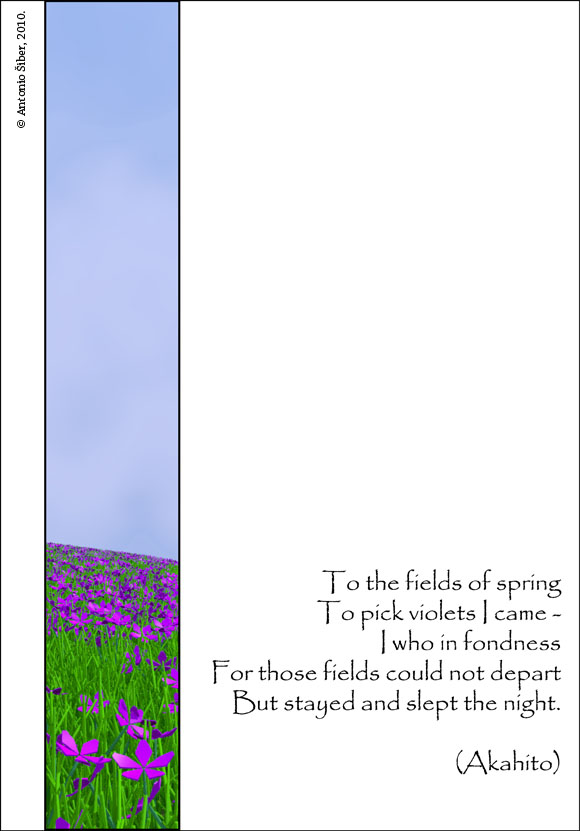
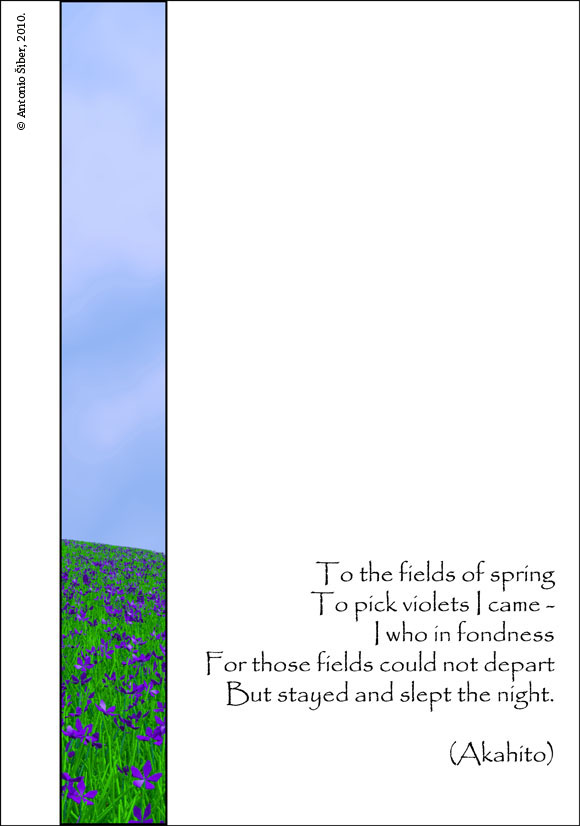
kitsch, but also the greatest feeling. When Akahito (700-736) says To the fields of spring to pick violets I came it
is on us to imagine the fields of spring and the violets. Those with more experience and those that are more susceptible
to natural phenomena will imagine more beautiful fields and more beautiful flowers, and they may even construct the field
that cannot exist in "reality", but that is some ideal of the field with violets, personally colored. Perhaps the feeling
will be enhanced by the experience that is not exclusively visual, e.g. by the warmth of the Sun or wetness of the grass or
some feeling that the reader had in those circumstances, perhaps when he was a kid - natural phenomena impress us the most
when we experience them for the first time and that is usually when we are kids. The whole story around "the field with
violets" can thus become particularly complex and beautiful feeling.
That is why a short form like waka or haiku can surely be both kitsch and valuable expression at the same time. It depends on
the interpretation. Interpretation is an important component of a work of art, it is difficult to imagine art without the
interpretation.
But, it is interesting that the need for interpretation also appears in physics. Here I mostly have in mind quantum
mechanics. Today physicists more or less agree that the theory of quantum mechanics is unique and whole, but that
its interpretation are many. Elementary interpretations of quantum mechanics are Heisenberg's, Schrodinger's and
Feynman's, but there are others, e.g. many worlds interpretation ( >> Hugh Everett,
>> David Deutch). That is where the physics approaches art. Yes, this
statement is both the stupidity, the truth and beauty, and you choose which of those suits you most.
The whole story of mine regarding waka and haiku was created after I read the book "Japanese haiku poetry" by late
Vladimir Devide, mathematician but also a great connoisseur of Japanese culture and language. After I read his book,
I can also say that Devide was an artist (the cover page is shown below, the first edition of the book is from
the 1970s).

I bought the book on a recently closed book fair in Zagreb - Interliber and I paid it less than 10 $. That was one of my better transactions. Devide tries to be impartial to the extent it is possible - that is in the "job description" of every mathematician and physicist. That is why he mostly cites the sources that are the basis for his judgments, he offers alternative translations of haiku poetry from other languages (English, Russian, German and French) and positions his translations accordingly. But, in some places one can hear Devide the artist. Devide as a man of deep feeling and understanding for poetry. After his translation of Ryusui's haiku (I offer here slightly modified translation of Peter Beilenson),
stumbling over the dark fields ...
catching fireflies
Devide says (my translation):
Beautiful. I recommend the book with all my heart, and the posts on haiku and waka are almost sure to still come.
| << Mighty Robots | A meeting of scientific council >> |
Last updated on 24th of November 2010.